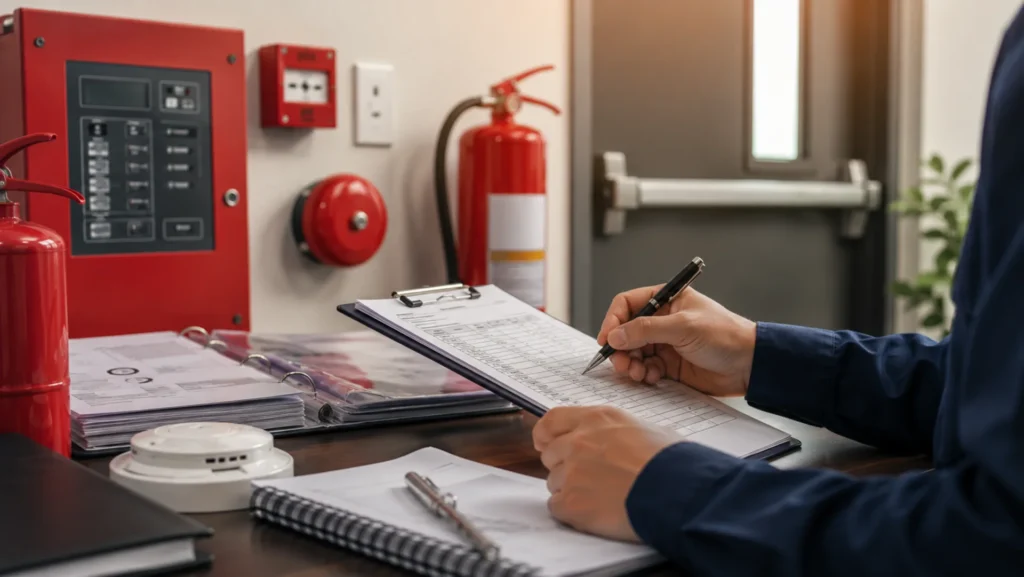
Do you know who determines how a fire alarm system must be designed, installed, and maintained? The answer is BS 5839. It is the British Standard that governs every fire alarm system installation in the United Kingdom, and it has implications for you as an owner/manager of a commercial property.
You do not need to become a fire safety expert to comprehend what it means. Let us make it simple to understand.
So What Actually Is BS 5839?
It can be viewed as the specification of fire alarm systems in non-domestic premises like offices, shops, warehouses, schools, hospitals, and everything. Its primary part is BS 5839-1, which deals with design, installation, commissioning, and maintenance of the fire alarm system.
The main point here is that BS 5839 does not provide requirements for the presence of the system in question in your premises. That is a responsibility of your fire risk assessment. But what it does is ensure the system works when it should work.
Notable fact: the standard was amended in April 2025. It means that, if your fire alarm system was installed before that date, it is time to check whether it is still relevant.
Why Should You Care?
But the fact is that a fire alarm system is only effective when it’s correctly designed. Here’s what correct design will provide you with:
- Firstly, it’ll save lives. A correctly designed fire alarm system allows you to detect the fire in time and therefore to escape.
- Secondly, it’ll keep your insurance policy valid. Normally, your fire alarm system needs to conform with BS 5839. Otherwise, your claim may fail.
- Thirdly, it’ll make sure that you comply with the law. And this is directly connected to UK fire safety legislation.
- And fourthly, it’ll reduce the number of false alarms. You don’t want to have the fire brigade coming every other week.
What Changed in the 2025 Update
The rules have been revised recently, following experience from fires. Here is a summary:
- Risks must now be assessed based on facts rather than assumptions.
- The paperwork has been tightened. Zone plans and documentation should be correct and up to date. You can refer to our “Fire alarm zoning guide for the UK” for further details
- There is new advice on evacuation procedures, including phased evacuation and voice alarms.
- Maintenance has been stressed more, with emphasis on regular testing.
- There are new requirements for cabling and detection equipment, in particular sleeping compartments.
If any of the above sounds familiar to you, it might be wise to talk to your installer.
The Different Types of System
BS 5839 categorizes all fire alarm systems based on the degree of interaction required from individuals:
- Category M – Call points only, without any automatic detection. Will only function when the individual is awake enough to trigger the alarm himself/herself.
- Category L – Inbuilt automatic detection intended to safeguard lives. The lower the number, the higher the level of coverage (L1 having the highest level).
- Category P – Intended to protect both the property and whatever is stored within it irrespective of whether anyone is there or not.
In most cases, commercial properties usually incorporate a combination of these.
Getting Your Installation Right
An effective fire alarm installation is more than just sticking detectors to a ceiling. This will include:
- Proper system design, based on your building and hazards
- Detection and alarm systems installed in places where they will function
- Documentation after system testing and approval
- Maintenance plan – preferably a twice-a-year service visit
Neglecting any of the above steps can result in an installation that may look appropriate, but won’t be. This is generally noticed only when it really matters.
Let Someone Else Worry About the Details
There is much to cover in BS 5839 and, quite frankly, you don’t have to be an expert in the process in order to conduct a fire alarm installation correctly. That is what a good fire & security partnership is all about.
Controlled Ltd has been doing this for over 25 years. Being a BAFE SP203-1 accredited company, the team provides the design, installation and maintenance of fire alarm systems for a wide range of businesses in the UK, including office and educational establishments, hotels and public sector facilities. All of which meet BS 5839.
Whether it’s time to invest in a whole new fire alarm installation, update an existing one, or get an inspection to make sure everything works fine, Controlled Ltd will gladly assist you in the matter. Contact us for a free consultation and relax!